Part 1
The Chicago prison cafeteria sounded like a storm trapped inside concrete. Aluminum trays scraped along bolted tables, plastic spoons clicked against stained compartments of food, and voices rose in rough currents beneath the flicker of fluorescent strips. Men in faded orange uniforms filled the room in rows, laughing too loudly, arguing too quietly, watching one another with the tired alertness of people who had learned that silence could be dangerous. The green-gray walls sweated cold. Dust hung in the hard light. Everything smelled of boiled vegetables, old metal, and locked doors.
At the far end of one table sat Mason Pike alone.
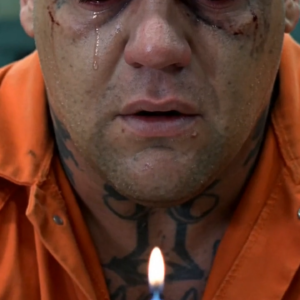
He looked like the kind of man no one should approach without a reason. His shoulders were broad enough to crowd the bench, his arms thick with dark tattoos that disappeared beneath the torn edge of his orange sleeveless uniform, and his close-cropped sandy hair made the lines of his skull seem harder. Men glanced at him and then away. Some respected him. Some feared him. Most had decided, long ago, that Mason Pike had no use for softness.
But his hands told a different story that afternoon.
They moved with painful care as he set a white napkin in the center of the scratched aluminum table. From the pocket near his hip he took a small piece of sandwich bread, not even a full roll, just a torn brown edge saved from lunch and pressed flat during the long morning. He placed it on the napkin as if it were fragile. Then, from beneath his tray, he removed a tiny blue candle, half-used and bent at the base, and held it between thumb and forefinger.
For a moment he only stared at it.
Around him, the cafeteria kept moving. Someone laughed near the service wall. A tray slammed. A guard blurred behind the distant gate, uninterested. Mason bent his head and pushed the candle into the bread with both tattooed hands. The soft piece folded around the wax, almost collapsing, but he steadied it and pressed again until it stood upright.
He took out a scratched lighter.
The first click failed. The second gave him a trembling flame. He shielded it with his palm, brought it close, and lit the candle. A small blue tongue of fire appeared, thin and stubborn against all the noise in the room.
Mason froze as if the flame had spoken.
His face changed slowly. The hard lines did not vanish, but something beneath them broke open. His red watery eyes fixed on the candle, and the muscles in his jaw worked once, twice, as though he were trying to swallow a sound no one was meant to hear. The flame reflected in his eyes. The tattoos on his neck shifted as he breathed.
He had not celebrated a birthday since he was seventeen.
That was the year his mother stopped visiting, the year his younger brother sent a card with no return address, the year he learned that a man could become terrifying simply by refusing to let anyone see him lonely. Every year after that, Mason had told himself the day did not matter. Numbers did not matter. A life could be counted in hearings, transfers, meal lines, and lights out. A birthday was a thing for free people, for kitchens with windows, for mothers who remembered what kind of cake their sons liked.
Still, he had saved the bread.
Still, he had hidden the candle.
Still, when the little flame stood in front of him, he began to cry.

Part 2
Mason tried to stop the tears before anyone saw them. He looked down, shoulders folding inward despite their size, but the first tear had already slipped over the rough skin beneath his eye. Then another followed, crossing the ink at the side of his neck. He closed his eyes. The cafeteria blurred into tray noise and fluorescent hum, and for one brief second he was not the man at the end of the table. He was a boy at a chipped kitchen counter, watching his mother light candles on a grocery-store cake while rain tapped the window.
He made his wish silently.
No one would ever know what he asked for. Not freedom. Not revenge. Not even forgiveness, though he had imagined that word so often it had become almost unbearable. Maybe he wished that somewhere, beyond walls and records and orange cloth, one person might remember he had been born. Maybe he wished to stop becoming harder every year. Maybe he only wished the flame would last another second.
Then he leaned forward and blew it out.
The candle died with a soft breath. A thin gray curl of smoke rose from the bread and wandered into the fluorescent light. Mason opened his eyes and stared at it with the helpless shock of someone who had done something private in the most public room in the world.
Across the aisle, Andre Bell lowered his plastic spoon.
He had been halfway through a mouthful when he noticed the smoke. His gaze moved from the candle to Mason’s wet face, and the spoon remained suspended in his hand. At the next table, Rafael Cruz stopped talking. He turned, saw the napkin, the bread, the bent little candle, and slowly rose from the bench. The movement drew more eyes. One by one, conversations thinned. Trays stopped scraping. A laugh died unfinished near the wall.
Mason felt the silence before he understood it.
He lifted his head.
Over twenty men in orange were looking at him. Some leaned over their trays. Some stood half turned from their benches. Andre’s face held no mockery, only something cautious and wounded. Rafael stayed on his feet, his hands open at his sides, as though one wrong movement could shatter whatever had entered the room. Even the men who normally filled the cafeteria with noise seemed uncertain whether to laugh, look away, or step closer.
Mason’s breath caught.
Shame rushed up first, hot and familiar. He reached for the napkin as if he could hide the bread, hide the candle, hide the tears still shining on his face. But his hand stopped above the table. The smoke kept rising between him and the staring room, a narrow gray thread holding everyone still.
Andre set his spoon down carefully.
The sound was small, but in the sudden quiet it carried farther than any shout. Rafael took one step away from his bench. Another inmate at the next table lowered his tray. No one spoke. No one mocked him. Not yet. That was what made the moment unbearable. Mason did not know whether the room was about to turn cruel or human.
His red eyes moved across the faces, searching for the first sign.
At the center of the table, the blue candle leaned in the torn dinner roll, its wick black, its smoke fading into the cold light. Mason’s hands trembled on either side of it. For years he had made himself into a warning so no one would see the wound beneath. Now the wound sat in front of them all, small as a piece of bread.
Rafael’s lips parted as if he might say something.
Mason waited.
The cafeteria waited with him.
Then the last thread of smoke vanished, and the room fell into black before judgment could decide what shape it would take.
The Puppy Looked Too Sick to Move—Until the Spoon Came Back
Mochi had discovered, sometime between breakfast and the late-morning sunbeam, that being dramatic worked better than barking. He was a small cream-gold dog with curls that fell over his sleepy eyes and a talent for turning ordinary comfort into a medical emergency. By eleven, he had arranged himself in the center of the beige leather sofa like a patient too delicate for the world. A gray fleece blanket covered his round belly. A white cloth rested across his forehead. His yellow teddy bear was tucked under his left paw, as if even stuffed animals had come to pay their respects.
The living room in the Austin house was quiet except for the soft hum of daylight through the curtains. Dust floated in the air. The sofa creaked beneath Mochi’s weight each time he breathed, which he did with the slow dedication of a tragic actor. His owner, Daniel, stood just out of frame with a white ceramic plate and the amused patience of a man who had already lost several battles.
Mochi had not been sick that morning. He had chased a sock, barked at a delivery truck, and stolen half a blueberry from under the kitchen table with impressive speed. But then Daniel had laughed and said, “No more treats until later.” Three minutes after that cruel announcement, Mochi had climbed onto the sofa, rolled onto his back, sighed like a retired king, and refused to move. When Daniel placed a hand near his nose, Mochi opened one eye to confirm that sympathy was being offered. Then he closed it again.
Now Daniel’s tattooed right forearm entered from the lower-right side of the frame, holding a small stainless spoon. The plate rested safely lower-left, far from Mochi’s paws. On the spoon was a soft bite of food, the kind of medicine a spoiled dog might accept if the household wished him to survive. Mochi’s ears stayed limp. His body did not rise. Only the tip of his nose twitched.
“Mochi,” Daniel said softly, trying not to laugh. “Are you going to make it?”
The dog blinked once, slowly, as if the question was rude and beneath him.
Daniel scooped the spoon with careful ceremony and moved it toward Mochi’s mouth in a straight, gentle path. The teddy bear stayed under the left paw; the cloth stayed on his forehead. Mochi kept his head back against the blanket,. When the spoon reached his muzzle, he opened his mouth just a little. His pink tongue slipped out, touched the food once, vanished, then returned for a second lazy lick. His jaw moved with the smallest possible effort, as though chewing might be too much strain.

Daniel’s shoulders began to shake. “Unbelievable,” he whispered. “You were just running laps around the coffee table.”
Mochi did not respond to slander. He swallowed, blinked, and settled deeper into the fleece. His chest rose and fell under the blanket, soft and steady. If a doctor had entered, the case would have been suspicious in seconds. Unfortunately for justice, the only witness was a yellow teddy bear, and the bear seemed loyal.
Daniel drew the spoon back along the same path. No food spilled. Mochi watched it leave with the faint disappointment of a patient who feared his treatment might be ending too soon. The plate clinked quietly when Daniel lowered the spoon. He paused, studying the dog’s limp paws, the spotless forehead cloth, the half-closed eyes.
“You know,” Daniel said, “real sick puppies don’t keep checking whether I’m making another bite.”
Mochi’s eyes shifted away immediately. He had made one mistake: he had followed the spoon with too much professional interest. To correct this, he let his head fall slightly to the side and exhaled through his nose. It was a delicate sound, full of suffering, dignity, and hope.
Daniel bent over the plate again, still smiling. The spoon began to gather another soft bite, but then he stopped. Something in Mochi’s face had changed. The little dog was no longer looking at him. Very slowly, with the cloth still on his forehead and the teddy bear held in place, Mochi turned only his eyes toward the camera.
There it was: the look.
Not pain. Not weakness. Victory.
His dark eyes were sleepy, smug, and impossibly calm, the eyes of a tiny patient who knew the act was working and intended to continue as long as the service remained acceptable. Daniel saw it and burst into quiet laughter. Mochi did not break character. He blinked once, licked his lips, and waited for the next spoonful with the patience of a dog who understood the power of pretending.
The room held in warm daylight: sofa centered, teddy still, spoon waiting lower-right, plate lower-left, and Mochi beneath his gray blanket, breathing softly like the most dramatic creature in Texas. Before Daniel could decide whether to reward the performance, Mochi gave the camera one final slow blink, as if to say that illness was temporary, but talent was forever.
Share
X
Telegram